|
History In The Making:
The Exxon and Mobil merger reunited the biggest pieces of John D. Rockefeller's Standard Oil monopoly.
In 1868, the Standard Oil
Company was organized in Pittsburgh, Pennsylvania. In 1870, the Standard Oil
Company was incorporated in Ohio.
Through a series of
acquisitions in a variety of petroleum interests, Rockefeller, in 1882,
organized them in New Jersey under the Standard Oil Trust moniker. That same
year marked the incorporation of two refining and marketing organizations --
Standard Oil Co. of New Jersey and Standard Oil Co. of New York. "Jersey
Standard" and "Socony," as they were commonly known, were the chief
predecessor companies of Exxon and Mobil, respectively. Within a decade,
the Standard Oil Trust controlled 90 percent of all oil produced in the United States.
The federal government brought suit against the Trust under the Sherman Anti-Trust Act, and in 1911, the Supreme Court broke up Standard Oil into 33 companies. Eight of those retained the "Standard Oil" moniker.
The newly independent Vacuum
Oil Company and Standard Oil Company of New York (Socony) separately marketed
fuels throughout the world until 1931 when the two merged. In 1955, Socony-Vacuum
became Socony Mobil Oil Co. and, in 1966, simply Mobil Oil Corp.
Meanwhile, Jersey Standard
acquired a 50 percent interest in Humble Oil & Refining Co. and marketed fuels
under multiple brand names including Esso, Enco, Standard, and Humble. In
1972, Jersey Standard changed its name to Exxon Corporation and established
Exxon as an uncontested trademark throughout the United States. In other parts
of the world, Exxon and its affiliated companies continued to use its
long-time Esso trademark and affiliate name.
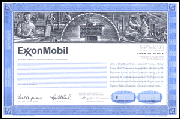
In 1998, Exxon and Mobil signed
a definitive agreement to merge and form a new company called Exxon Mobil
Corporation. After shareholder and regulatory approvals, the merger was
completed November 30, 1999.
The merged company, Exxon
Mobil Corporation is now based in Irving, TX with major U.S. divisional
offices in Fairfax, VA and Houston, TX. It employs a combined 106,000 people
worldwide. At the completion of the merger, the company had about 7 Billion
shares outstanding with a Market Capitalization of just under $280 Billion.
Some of the other formerly well known "Standard Oil"
companies include BP (which purchased Amoco formerly Standard Oil of Indiana,
also purchased SOHIO formerly Standard Oil of Ohio). Chevron Texaco (specifically Chevron)
which was
formerly Standard Oil of California & Standard Oil Of Kentucky.
Continental Oil Company became Conoco and presently under the umbrella of
ConocoPhillips. In 1966 Atlantic Refining merged with Richfield to become
ARCO. Subsequently, in 1985, ARCO divested its East Coast marketing
and refining operations which, in turn, was
eventually acquired by Sunoco. A significant remainder of ARCO is now part of
BP Corporation. |